Childhood in Ancient Egypt
Depictions of childhood
Children in ancient Egyptian art could be distinguished from adults through a variety of features. A common characteristic is that they were often shown to be unclothed. Rather than reflecting reality and daily life, this was an artistic convention to define them as children and avoid confusion with adults. Another identifying feature is the sidelock of youth, also known as the Horus lock. This was a single plait of hair that both male and female children could be portrayed with, but they were most commonly used to signify elite or royal children. This convention served as a marker of both status and age. A child might also be depicted by the pose of holding a finger to their mouth. This was the ancient Egyptian equivalent of thumb-sucking, and it symbolised youthful and childish behaviour – as famously seen in representations of the child god Harpokrates. Together, these clues created a recognisable visual language for children in the artistic record.
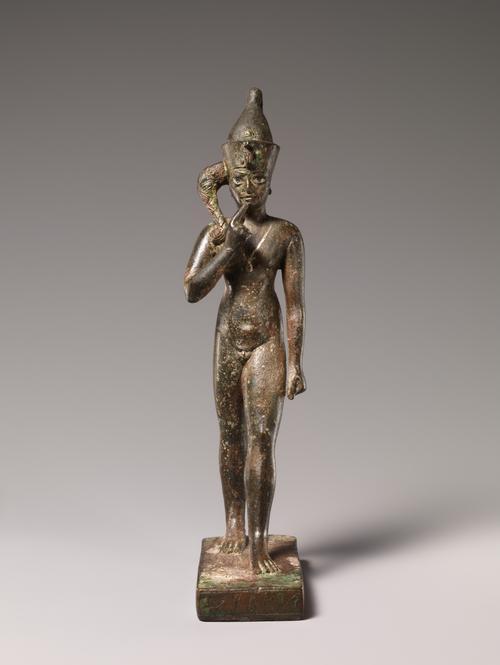
A figure of the child god Harpokrates, with his sidelock of youth and childish gesture. Now in The Metropolitan Museum of Art
Toys
Did ancient Egyptian children play like we do today? There is archaeological evidence of what we might consider to be toys. Some artefacts have been described as mechanical toys and seem to have no practical use other than being for entertainment. This wooden model of a horse has four wheels and a loop for it to be pulled along by a string. It’s quite similar to toys we have today!
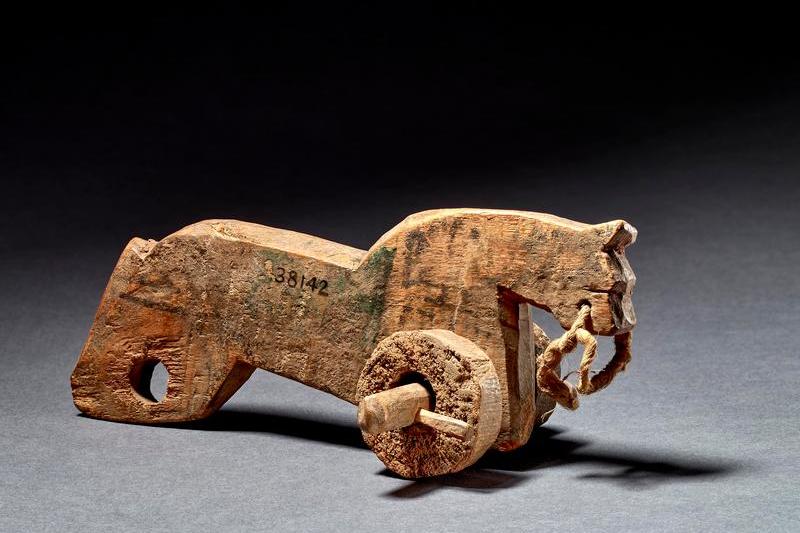
A toy wooden horse which could be pulled along by a string, currently in the British Museum (EA38142).
However, it can be difficult to identify an object’s original intended use, and so we cannot be certain that certain artefacts were in fact used as toys. This would assume that children in ancient Egypt played for fun in the same way that we do, but the idea of learning and fun was not the same in ancient societies. Learning was more of a survival skill, as seen with this child’s slingshot from Kahun. This was small enough for a child to use and would have been useful for hunting birds. It had an element of play, but also a practical use for contributing towards family life, as well as developing hand-eye coordination. There isn’t always a clear definition between play and learning with artefacts like this, but they give valuable insight into the lives of children and how they prepared for adulthood.
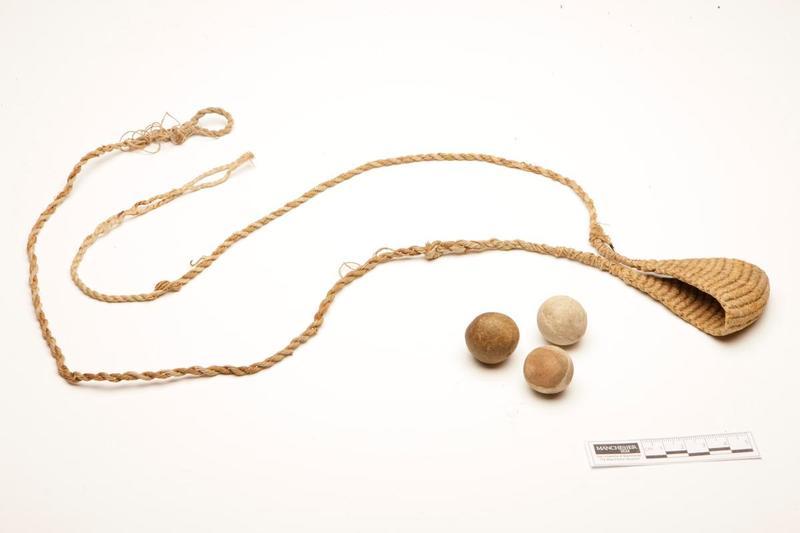
A slingshot made from plant fibres and three stones, currently in the Manchester Museum (103).
Work and School
For most children, childhood wasn’t a long period where they could simply enjoy life. Children had to work from a very young age to support their families, with simple tasks like pressing amulets into lumps of clay to make moulds. Fingerprint analysis on these moulds shows that children as young as ten were working in workshops. Other jobs included carrying water, carrying out agricultural work and laying bricks. This observation and practice could then lead to more professional tasks, where family positions could be passed on.
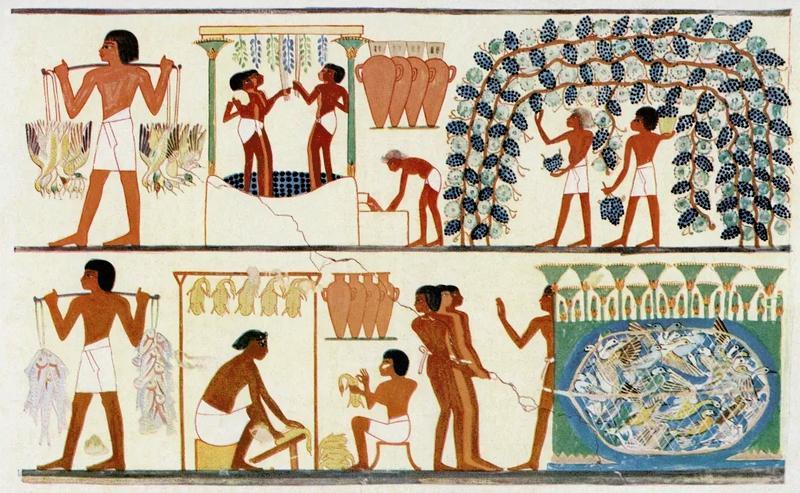
An agricultural scene from The Tomb of Nakht (TT52).
Factors such as family background, gender and age determined what a child’s life would look like. Children from more elite and royal backgrounds had the opportunity to receive some form of schooling. Unlike schools today, most teaching was apprenticeship or tutor based. However, there were larger scribal schools attached to temples and palaces. Texts such as The Satire of the Trades are evidence of handwriting practice and moral instructions taught in scribal schools.
Look, there is no profession free of directors, except the scribe – he is the director. If, though, you know how to write that is better life for you than these professions I show you; the protector of the worker or his wretch the worker?... A day in the school chamber is more useful for you than an eternity of its toil in the mountains.
Children also had the opportunity to receive a direct one-on-one education on subjects such as writing, mathematics and craftsmanship. Although the lives of young girls were centred around domestic life with their mothers, we know of literate women who may have been taught by male family members too.
Ancient sources were selective in what they chose to record, and elements of childhood, such as growing up and family life, were not usually documented. While this makes it challenging to form an accurate idea of childhood, we can still get a glimpse into how children lived through snippets of textual sources, toys and artistic depictions.