Disability has existed throughout human history, including in ancient Egypt. In fact, due to the incredible preservation environment in Egypt, such as the arid desert in which the ancient Egyptians built their tombs, we arguably have more evidence for disability than many other ancient cultures. There is a range of textual, visual, and material culture related to disability. While disability is most cited in studies of human remains, however, due to medical model framing, disability is rarely explicitly mentioned. Instead of ‘disability’ these studies often study paleopathological evidence for a disease with little or no mention of the person. The field of Disability Studies has named and challenged the medical model, which studies a person as if their sole relevance is the existence of a disease. In Egyptology, it is usually by retrospectively diagnosing a disease from preserved human remains and assuming – without further study – either marginalisation, suffering and/or inferior status based on the presence of a disease.
Disability Studies instead explore disability as a complex lived experience encompassing all aspects of the person’s life, including their intellectual or bodily differences. This field emerges out of activist movements during the 1970s and is now an academic discipline that studies the nature of disability and ableism, mostly in today’s society.
Previous scholarly views
While there is a lot of evidence that could cover disability, until recently, it has been understudied in Egyptology. During the 17-20th centuries, the typical view of disability was that it was always negative and the result of karma or divine punishment from moral failings. After the so-called ‘Age of Enlightenment’ in Western scholarship, where natural sciences were expanded, disability was viewed as a biological deficit.
These biased assumptions remained the main view of academic scholarship for a long time. Since about 2010, research has shifted to a more identity-based model. In an identity model, disability is studied without assuming negative consequences. New research in this space uses theoretical paradigms from critical disability studies and has been primarily led by early career researchers who have lived experience of disabled identities. This has also run concurrently with research into disability using similar approaches in ancient Greece and/or Classics as exemplified in the work of Debby Sneed, Hannah Silverblank, and Marchella Ward amongst others (see below).
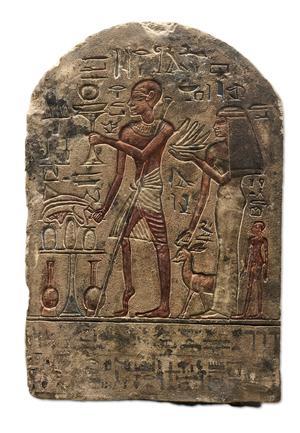
Funerary stela of Roma, a temple doorkeeper and priest of Astarte, shown with his wife and their son. Roma leans on a long staff, and one of his legs is depicted thinner, with the heel raised. Painted limestone, 18th Dynasty, Ny Carlsberg Glyptotek, AEIN 134.
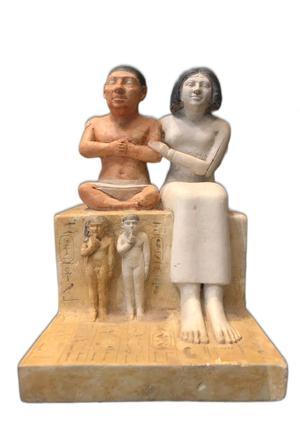
Statue group of Seneb, an Old Kingdom official of short stature, with his wife Senetites and their two children. Painted limestone, from Seneb's tomb at Giza, Old Kingdom, circa late 5th or early 6th Dynasty. Egyptian Museum, Cairo.
What evidence do we have?
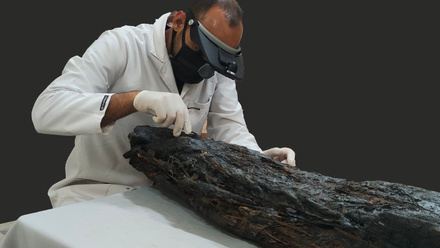
In terms of ancient Egyptian evidence, we can take any number of bioarchaeological studies to explore the impact of pathology on the body, with which we can then interpret or infer disability. Our work uses critical disability studies theory to explore more complex and less ableist research on disability. While there is a lot of evidence for disability in human remains, there is also evidence for disability related material culture, such as walking sticks or prosthetics. For example, there is an example of a prosthetic big toe fitted to the remains of a mummified woman believed to be the daughter of a high-status ancient Egyptian priest from 3,000 years ago. It is made of wood and leather, and a study by Finch in 2018 has proven it was actually used in life.
There are various representations of disability in visual and material culture from ancient Egypt. Some key examples which you may have already considered are:
- A range of bodily differences in wall scenes from Old Kingdom tombs. For example, there are many representations of dwarf persons.
- We have the very famous statue of Seneb and his family. Seneb was an official during the Old Kingdom (c. 2686–2181 BC) and was depicted in all of his mortuary representations with short stature.
- You may also have thought of the dwarf god Bes who is often represented in amulets.
- Or the so-called blind harpists represented in New Kingdom tombs.
- There is the famous example of the funerary stela of Roma, a temple doorkeeper and priest of Astarte. Roma is depicted on this stela leaning on a long cane or staff. He has a clear lower-limb impairment with one of his legs depicted thinner and heel raised to avoid weight bearing.
- In textual sources, we have medical texts and magical literature (acknowledging medical/magical are connected). One of the most famous direct mentions of what we usually would call disabilities is in Chapter 25 of The Instructions of Amenemope, a literary work ostensibly written by scribe for his son which stressed the importance of treating disabled people with respect “Do not laugh at a blind man, nor tease a dwarf...” (Lichtheim 1984: 165). Also, for example magical texts describe various medicinal and magical remedies for the symptoms of a range of conditions.
While older scholarship has referred to these examples as proof of survival or “inclusion” being exceptionally better in ancient Egypt than the rest of the ancient world, newer scholarship argues this is a generalisation. Vogel and Morris instead suggest that disability is a complex experience, different for everyone, and intersects with other forms of identity. Their book Disability in Ancient Egypt and Egyptology: All Our Yesterdays is a distinct shift away from this framing. They encourage authors and readers to be careful of the framing of our historical narratives, and engagement with disability studies is one means to do so.
Resource list
It is important to be careful about the terminology and phrasing you use when discussing disability, even in relation to the ancient world. For some recommendations and guidelines:
Alexandra F. Morris and Debby Sneed. “Blog: A Brief Guide to Disability Terminology and Theory in Ancient World Studies,” August 30, 2021, Society for Classical Studies Blog.
Hannah Vogel and Kimberly Harris “Making your research and teaching practices accessible: An AWAWS workshop,” June 21, 2021, Australian Archaeological Institute at Athens Blog.
Further reading
For more research on disability in the ancient world that uses Disability Studies see:
Finch, Jacky. “The Complex Aspects of Experimental Archaeology: The Design of Working Models of Two Ancient Egyptian Great Toe Prostheses.” In Prostheses in Antiquity. 1st ed., Vol. 1, edited by Jane Draycott, 29–48. London: Routledge, 2018.
Morris, Alexandra F. “Let that Be Your Last Battlefield: Tutankhamun and Disability.” Athens Journal of History 6, no. 1 (2020): 53–72.
Morris, Alexandra F. Disability in Ptolemaic Egypt and the Hellenistic World: Plato’s Stepchildren. London and New York: Routledge, 2025.
Morris, Alexandra F. and Hannah Vogel (editors). Disability in Ancient Egypt and Egyptology: All Our Yesterdays. London and New York: Routledge, 2025.
Silverblank, Hannah and Marchella Ward. “Why does classical reception need disability studies?” Classical Receptions Journal 12.4 (2020): 502-530.
Sneed, Debby. “Disability and Infanticide in Ancient Greece,” Hesperia 90.4 (2021): 747- 772.
Sneed, Debby. “The Architecture of Access: Ramps at Ancient Greek Healing Sanctuaries,” Antiquity (2020): 1-15.
Vogel, Hannah, and Ronika K. Power. “Recognising Inequality: Ableism in Egyptological Approaches to Disability and Bodily Differences.” World Archaeology (2023): 1–14.
Ward, Marchella. Blindness and Spectatorship in Ancient and Modern Theatres Towards New Ways of Looking and Looking Back. Cambridge: Cambridge University Press, 2023.
Zakaria, Nevine Nizar. “Unveiling Hidden Histories: Disability in Ancient Egypt and Its Impact on Today’s Society—How Can Disability Representation in Museums Challenge Societal Prejudice?” Social Sciences 13.12 (2024): 647.