
Hekhanakht – The Landowner
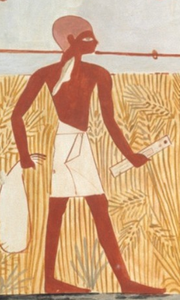
My name is Hekhanakht, and I am living proof that a man can live more than one life simultaneously!
I was born in the Nile mud. I am the son of a farmer whose hands were as cracked as a serpent’s skin and owned nothing but a patch of land and a few stubborn cows. I grew up learning to watch the Nile, anticipating its moods. When it rose too high, it ate your walls, but if it rose too low, it ate your future. The Nile is our lifeline and provides us with bountiful crops, but it can also be tempestuous and take away what is dear to us.
Now, I manage a household of 18 souls. 18! I built this life on my own with hard work and perseverance. I have fields of barley for bread and beer, flax for linen, oil seeds for trade, and herds of cattle to press the grain into the earth after the waters recede. I am owed many favours, deben or grain by 28 men! Among them is Herunefer, sharp as the flint blades on a sickle, and owner of neighbouring land, who makes advances not only on my daughter, but on my fields too.
However, despite all my success, I am pulled tight like a rope around a donkey. My home is Nebsyt. It is my soil, my breath. But I serve as a ka-servant, a priest involved in funerary rites, in distant Thebes, and when duty calls, I must leave everything behind. The fields, the ledgers and a fragile peace in my household. I write letters constantly: Take great care! Watch over my seed-corn! Look after all my property! This is the only way to have contact with home. Most men born like me never learned writing, but words are my second pair of eyes. My steward Merisu keeps the accounts. Nakht shouts at the labourers. Sinebniut watches the cattle like a hawk. But still, I worry – I always worry.
Especially about my wife, Iutenhab, or Ip for short. She is young, bright as the sun, and the house resents her shine. They are jealous and whisper about her, even preventing her from seeing her hairdresser! Last month, I had to order Merisu to dismiss Senen, a servant girl full of malice, for speaking cruelly to her. How dare anyone behave in such a way towards my lotus flower. Since then, the house has been simmering like the Great Green Sea in a storm.
But there is no time to dwell on these things. It is Shemu, the season of harvest, and there is much work to be done before the coming of Akhet, when the Nile covers the fields. When the waters come, the land disappears, and everyone can rest. Everyone but me, that is. For now, the fields are alive – the workers move back and forth in the blistering sun, the air filled with the rhythmic swish and snap of sickles cutting the ripe stalks. The seeds were sown late in Peret, (the season of emergence), yet praise Ra, the harvest is abundant – so is the dust. Behind the cutters come the women with baskets, balanced on their hips, as they collect the golden yield they left behind. I watch them and feel a quiet gratitude for their hard labour – it is by their sweat that I am fed – and my other 18 mouths... At the end of the line come the scavengers – the old, the young and the crippled, with little or nothing of their own. They search the stubble for what the harvesters have missed. I do not drive them away – they too must eat and such is the order of the world – those who have, must help those who have not.
Before I leave for Thebes, I will return for the inspection – after the cattle hooves have trodden the grain, to watch the winnowing and to deal with anyone caught stealing. I am a kind master, but I am firm one – Ma’at must be upheld.