
The Tale of the Shipwrecked Sailor
Description and Translation
Perhaps the most fantastical of the Ancient Egyptian narrative tales is contained in Papyrus Leningrad 1115 and known as the Tale of the Shipwrecked Sailor. Discovered by Vladimir Golenishchev in 1880, the papyrus dates to the Middle Kingdom.
The narrative opens with the sailor addressing the commander of an expedition by sea on their journey home. It appears that the expedition has not been successful and the commander is apprehensive about how this will be received by the king. The sailor tries to cheer him up by describing something that happened to him. He had been on an earlier sea expedition to the mining region in a boat 120 cubits long and 40 cubits wide with a crew of 120.
A cubit is based on the length of a human forearm from the elbow to the tip of the middle finger. If we use 18 inches or 46 cm, the boat would have been 55 metres long and 18 metres wide. Although this sounds improbably large, archaeologists have found remains of cargo ships of similar size.
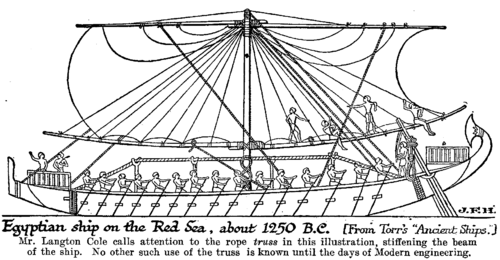
Perhaps the boat described in the tale looked somewhat like the boat above.
This ship was hit by a storm and the sailor was the only survivor. He was conveniently washed up on an island which was abundant in fruit, vegetables, fish and fowl. ‘There was nothing which was not in it’. He ate his fill and made a fire to make an offering to the gods.
‘Then I heard a noise of thunder;
I thought it was a wave of the sea,
for the trees were splintering,
the earth was shaking;
I uncovered my face and found it was a serpent coming.
There were 30 cubits of him.
His beard was bigger than two cubits,
his flesh overlaid with gold,
and his eyebrows of true lapis lazuli.’
The serpent is described with the attributes of a god, so the sailor is afraid and quickly launches into an explanation of his presence on the island. The serpent tells him not to be afraid and that he will be on the island for four months after which a ship will come from home to rescue him. In the meantime, the serpent tells him what happened to his family comprising seventy-five serpents in all. They were killed by a falling ‘star’ when he was elsewhere, only the daughter he had taken with him having survived.
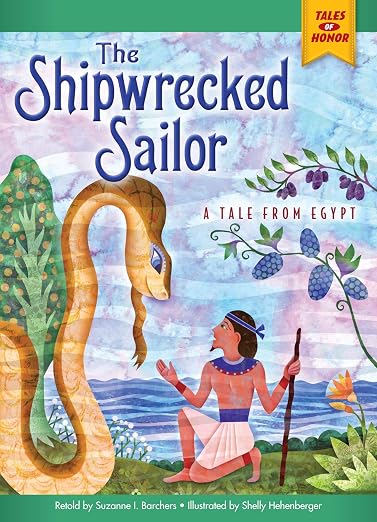
Hehenberger, S. (Illustrator), Barchers, S. I. (Adapter), The Shipwrecked Sailor: A Tale from Egypt (Tales of Honor). Red Chair Pr.
The serpent tells the sailor that if he is brave he will reach home - ‘you will fill your embrace with your children, kiss your wife, and see your house!’
The sailor says that he will cause all kinds of offerings to be brought to the serpent in thanks, but the serpent says that ‘I am the ruler of Punt’ and that he does not need the offerings as he already has these things in abundance. In any case, the sailor will not see the island again as it ‘will have become water’. The rescue boat appears as promised and the sailor leaves with valuable cargo given to him.
The sailor suggests to the commander that if he is brave and speaks well before the king he will not suffer for the failure of the current expedition, but the commander remains despondent – ‘Who pours water for a goose, when the day dawns for its slaughter on the morrow?’ – a depressing end to the tale.
Meaning
This tale is held up as a forerunner to more modern classic sea stories such as Sinbad the Sailor and The Rime of the Ancient Mariner showing how similar themes can still resonate with people today.
There are many religious references in the tale which would have been understood by an educated audience but if it was performed for a less literate audience might have gone over their heads. For example, the island is described has having all kinds of fruit and vegetable as well as fish and fowl which is reminiscent of the standard funerary offering formula. Is this the afterlife? The serpent refers to the island as ‘of the spirit’ so not of the real world. The serpent has a beard and is overlaid in gold with lapis lazuli – all attributes of kings or gods. The number 75 (members of his family who were killed) is the same as the number of forms of Re in The Litany of the Re. The daughter who is saved may refer to the goddess Maat, the daughter of the Re.
The land of Punt is thought to be in the region of modern-day Eritrea – it was a land full of riches and exotic items and expeditions were sent there from Egypt to obtain these goods. Finally, the sailor’s promised return home means a return to normality and the real world.
The whole tale is meant to emphasise the value of speaking and experience but the commander at the end does not accept this.
References
Parkinson, R. B. 1997. The Tale of Sinuhe and Other Ancient Egyptian Poems 1940-1640 BC. Clarendon Press.
Foster, J. 1998. The Shipwrecked Sailor, A Tale from Ancient Egypt. Columbia University Press