
The Tale of Sinuhe
This tale is regarded as one of the best examples of Middle Kingdom literature. Several copies have been found dating over many years, although some are only fragments. This indicates that it must have been popular for a long time. The main sources are Papyrus Berlin 3022 from the 12th Dynasty. Parts missing from this text were present in Papyrus 10499 from the end of the Middle Kingdom and an ostracon in the Ashmolean Museum from the 19th Dynasty.
Interestingly the story inspired a famous Finnish author, Mika Waltari, in his writing of ‘Sinuhe, The Egyptian’ which was made into a film in 1954 ‘The Egyptian’. Set in the New Kingdom, the main character is named after the Sinuhe of the earlier text.
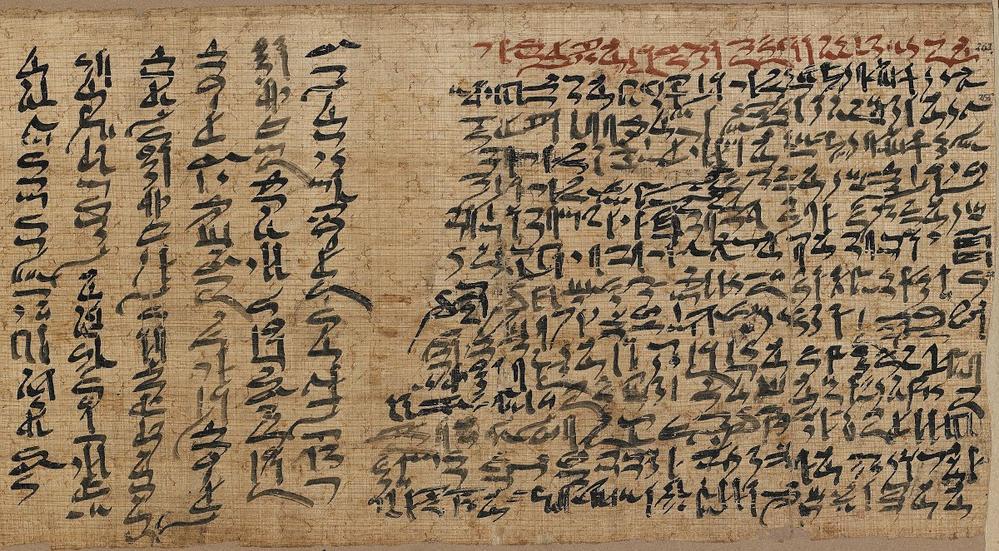
Four papyrus copies of the Tale of Sinuhe are known from the Middle Kingdom, and so this is one of the best-attested literature texts from the period. The above shows an excerpt from one of these papyri, known as Text B, created during the reign of Amenemhat IV., 1807–1798 BCE. (Ägyptisches Museum und Papyrussammlung, Staatliche Museen zu Berlin, P. Berlin 3022).
Description and Translation
The story is set at the end of the reign of Amenemhat I. Sinuhe, a court official, in service to the Princess Nefru (wife of Senusret), is on an expedition led by the king’s eldest son, Senusret, which is returning from Libya when they are met by ‘the friends of the court’ an inner circle of courtiers to inform Senusret of his father’s death. Senusret immediately departs for the Residence (Itjtawy, near the Fayyum oasis) with an entourage. At this point one of the other royal children on the expedition is summoned to be told the news and Sinuhe overhears as he is standing nearby (although out of sight) on duty. Something he hears terrifies him because he immediately hides and then heads south as he expects trouble and he ‘did not think to live after him’ (the king). From ‘The Teaching of King Amenemhat’ we know that the king was assassinated and perhaps Sinuhe fears being implicated somehow.
There then follows a description of his journey, travelling by night, until he encounters a Syrian leader who recognises him from when he had visited Egypt. This individual takes him to his tribe from where Sinuhe heads to Byblos and then Qedem. From here he is taken by the ruler of Retjenu, Amunenshi, to his court where there are other Egyptians known to Sinuhe.
Sinuhe then has to explain why he has left the court, but he ‘spoke in half truths’ and says ‘I do not know what brought me to this country – it is like a plan of God’. He then launches into a lengthy description of how wonderful the new king is, doing all the things a good Egyptian king should.
Amunenshi takes Sinuhe under his wing. He places him at the head of his children and marries him to his eldest daughter. Sinuhe is given land which was abundant in fruit, wine, honey, grains, cattle, etc. He is appointed as the ruler of the choicest tribe of the country. He has the best of everything and spent many years there leading missions as the commander of Amunenshi’s army.
One day, a ‘hero of Retjenu came to provoke me in my tent’. Sinuhe meets the challenge of this individual, defeating and killing him in a fight and taking all his wealth. Sinuhe reflects that God has been gracious to someone with whom he was previously offended and led astray to another country. He mourns his lost place in the Residence of the king of Egypt and yearns to go back to die and be buried there.
Senusret hears of Sinuhe’s situation and sends a royal decree to the effect that Sinuhe’s self-exile was his own decision and he should return to Egypt where he belongs, and in due course he will receive a proper burial with all the appropriate accoutrements and rituals.
Sinuhe is overcome at this news and launches into another description of how wonderful the king is and also saying that he does not know why he fled in the first place. He hands over his property to his children and heads for Egypt where he is received with great ceremony and showered with property and goods as well as the wherewithal for a good burial.
Meaning
A lot of themes important to Egyptian culture are covered within this text. First and foremost is the acceptance that Egyptian culture is better than any other and you cannot live a worthy life away from Egypt, and in Sinuhe’s case, away from the king. There is the importance of conforming in Egyptian society and the concept of order and justice (Ma'at) as opposed to chaos elsewhere. While Sinuhe is in ‘exile’ he has adopted local dress and customs – this is all reversed when he returns and is shaved and given fresh clothing. Above all is the importance of a burial at home with all the proper rituals – Sinuhe abandons his family, wealth, and position in Retjenu mainly for this.
The name Sinuhe is translated as ‘Son of the Sycamore Tree’. This tree is associated with the goddess Hathor who is connected with fertility and rebirth. She is referenced in the text when Sinuhe is crossing water near the Sycamore. It has been suggested that this infers that Sinuhe is travelling under divine guidance and not just running in a panic. His return to Egypt can be interpreted as a rebirth.
References
Parkinson, R. B. 1997. The Tale of Sinuhe and Other Ancient Egyptian Poems 1940-1640 BC. Clarendon Press.
Lichtheim, M. 1975. Ancient Egyptian Literature Vol 1: The Old and Middle Kingdoms. University of California Press.