
The Lost Temple of Armant
Hieroglyphic inscriptions of Cleopatra's temple in Armant through the eyes of early travellers
An ASTENE Grant supported project directed by Christophe Thiers.
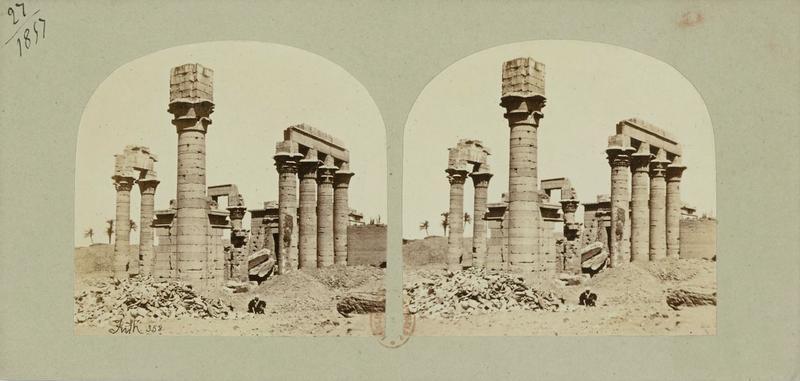
Continuing their Egyptian journey south of Thebes, early travellers in the 18th and 19th centuries invariably stopped at Armant, the ancient Hermonthis. The temple’s reputation arose from the belief that its construction marked the birth of Caesarion, the son of Cleopatra and Caesar: it was a mammisi (birth-house), proclaiming the birth of the local young god Harpre.
Despite appeals from Jean-François Champollion to the viceroy of Egypt in 1829 regarding the destruction of the temples, and later from George Robins Glidden in 1841, the dismantling of Egyptian monuments continued unabated until the 1860s. The Armant mammisi was completely dismantled in 1861–1862 to build a sugar cane factory, which is still in operation at Armant.
Alongside my fieldwork at Armant (IFAO and CNRS) since 2004, I began gathering documents (published and in public archives) and studying the hieroglyphic inscriptions of the mammisi. Members of the first scientific expeditions (Description d’Égypte, Jean-François Champollion and Ippolito Rosellini, and Karl Richard Lepsius) published some of the most intriguing reliefs. In addition to plans and sketches, other scenes and hieroglyphic inscriptions were copied by early travellers and also photographed (Maxime Du Camp, Félix Teynard, Francis Frith). These largely unpublished manuscripts are of the greatest importance and must be thoroughly studied. Archival records will undoubtedly provide a wealth of information about Cleopatra's temple in Armant. They are held in various institutions, in Europe and Egypt.
The project aims to provide the most complete set of hieroglyphic inscriptions, based on copies made by travellers and early Egyptologists who visited Armant in the 19th century. It will complement the publication by Daniela Rutica, Kleopatras vergessener Tempel (2015), which is devoted to the wall decoration. I would like to focus on different types of data that are most valuable for enhancing this project:
- Anthony Charles Harris (1790–1869) was a merchant based in Alexandria, as well as a collector and scholar. His archives (drawings and notebooks) are kept in the library of the Greco-Roman Museum in Alexandria. The complete set of original archives still needs to be checked and studied.
- John Gardner Wilkinson (1797–1875), British Egyptologist and traveller, made several sketches and copies of hieroglyphic inscriptions at Armant during his trips to Upper Egypt (1841–1842 and 1855–1856). This valuable documentation is preserved at the Bodleian Library in Oxford. It seems necessary to examine this complete set of archives in Oxford, along with other early travellers documents (e.g. Edward William Lane, Robert Hay) housed there and at the Griffith Institute.
- The final set of data I wish to study was collected during the Prussian Expedition led by Karl Richard Lepsius (1810–1884). A thorough examination of the original squeezes and Lepsius’s notebooks, held in Berlin at the Staatliche Museen (Ägyptisches Museum und Papyrussammlung), should yield reliable results in establishing the hieroglyphic texts as accurately as possible.
The study of these hieroglyphic inscriptions will significantly enhance our understanding of the deities and theology of this renowned lost temple.